Orillia Septic arranges complete septic system installations across Simcoe County — and the first thing worth saying plainly is that "installing a septic system" is not one job. It's seven, in a fixed order, and skipping or reordering any of them is how homeowners end up paying twice.
Orillia city proper is mostly on municipal sewers. The septic market is everything around it: Oro-Medonte, Severn and Ramara, plus the cottage and year-round properties strung along Lake Couchiching, Lake Simcoe and Bass Lake. Out there, every new build, every winterized cottage and every added bedroom means a private sewage system designed for that specific lot.
The seven steps of a septic installation
- 1. Site evaluation and soil test — test pits are dug and the native soil is assessed for how fast it percolates, how deep it runs before bedrock, and where the seasonal high water table sits. This single step decides your price tier before anyone quotes a number.
- 2. Design by a BCIN-qualified designer — daily design flow is calculated from the number of bedrooms and fixtures, the tank is sized, the bed is laid out to scale with every setback from wells, lot lines, structures and the water's edge, and a replacement area is reserved.
- 3. Municipal permit — the design goes to the local municipality or health unit for a sewage system permit under Part 8 of the Ontario Building Code. Nothing gets dug until that permit is issued. Full detail on our permits page.
- 4. Excavation — the tank hole and the bed footprint are cut, unsuitable material is removed, and on replacements the old system is decommissioned at the same time.
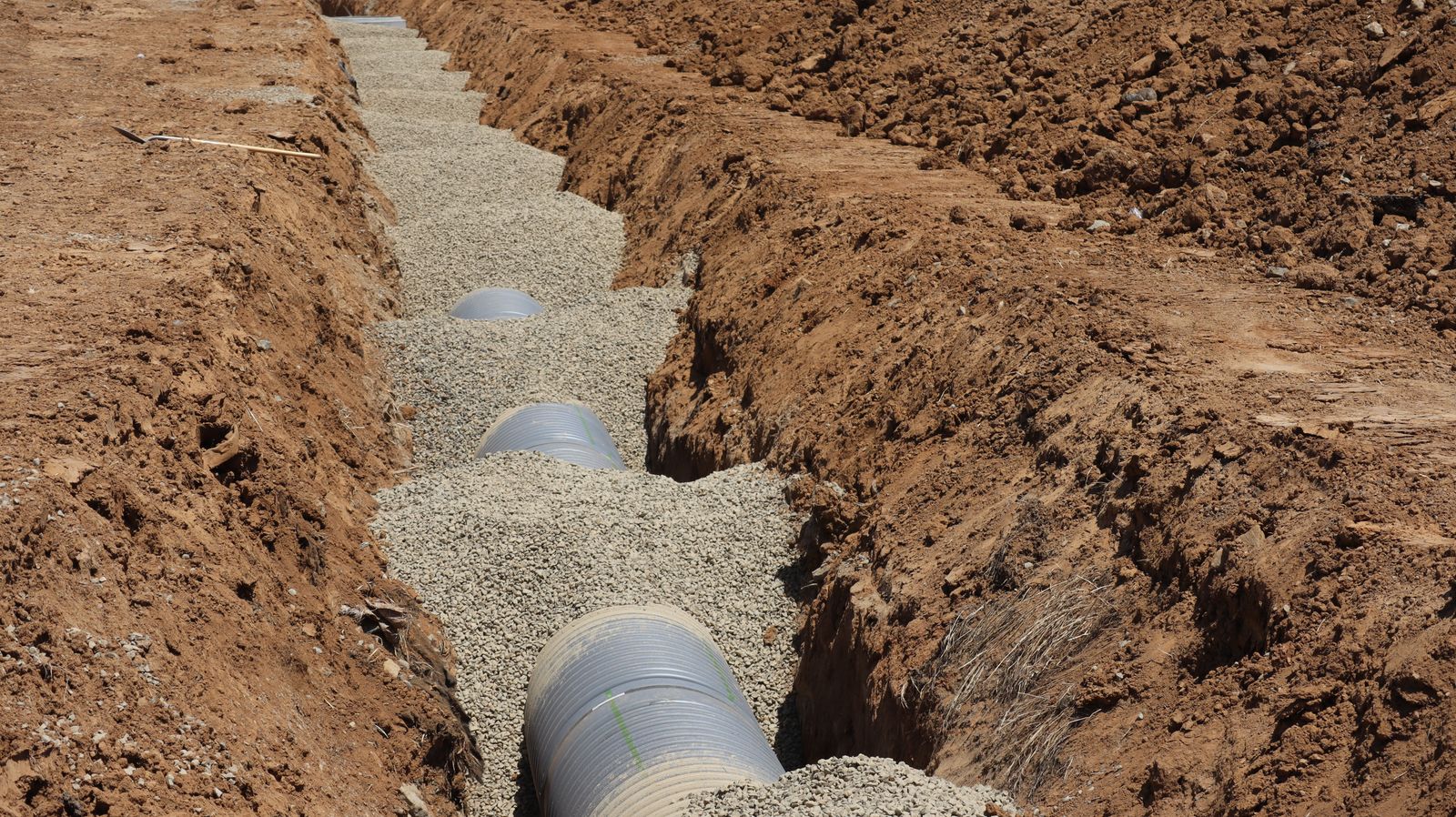
- 5. Tank and bed installation — the tank is set and levelled, the distribution piping is bedded in clean stone at the specified grade, and imported fill or a treatment unit goes in where the design calls for it.
- 6. Inspection — the inspector sees the system open, before backfill. This is not optional and it is not a formality; it is the moment the permit becomes closeable.
- 7. Backfill and final grading — the bed is covered, contoured to shed surface water away from it, and topsoiled and seeded so the yard drains the way the design assumed.
What decides the type of system you get
Homeowners often ask for "a normal septic system" and are surprised when the design comes back as something else. The design isn't a preference — it's arithmetic on the soil report.
A conventional system is a septic tank plus a leaching (tile) bed sitting in native soil. It's the cheapest and simplest option, and it needs the lot to cooperate: enough depth of suitable soil, a water table well below the bed, no bedrock in the way. When the lot cooperates, a conventional install runs $18,000–$40,000.
When it doesn't — poor percolation, shallow bedrock, or a high water table, all of which are common on rocky lakefront lots around Bass Lake and the Couchiching shoreline — the treatment zone has to be built above grade with imported material. That's a raised or fill bed, $35,000–$50,000. And where the lot simply doesn't have the room, or shoreline setbacks eat the available area, the effluent gets treated to a higher standard first so a smaller dispersal area works: an advanced treatment unit, $40,000–$60,000+. The full breakdown of what moves the number inside each tier is on our cost page.
Timeline: days on site, weeks on paper
The construction phase is short. Most residential installs take 2–5 days on site once the permit is in hand — a day or two of excavation, a day to set tank and bed, then inspection, backfill and grading. What people underestimate is everything upstream: the soil test has to be scheduled, the design drawn, and the permit reviewed by the municipality or health unit. That review adds weeks, and it adds more of them in spring when every deferred file in the county lands at once.
Then there's the season. Excavation runs roughly April to November in Simcoe County; frozen ground shuts the rest down. A system designed in October gets permitted over winter and built in spring. If you're working against a build schedule or a compliance order from a re-inspection program, the soil test is the thing to book first — not the excavator.
What's included in a proper install
A complete installation quote should cover the site and soil assessment, the BCIN design and drawings, the permit application and fee, excavation and disposal of unsuitable material, the tank, the distribution piping and stone, imported fill or the treatment unit where specified, all inspections through to final sign-off, and rough grading with topsoil and seed. If a quote is missing the design fee, the permit or the restoration, it isn't cheaper — it's incomplete.
New builds and vacant lots
On a vacant lot, test the soil before you commit to a house plan. The system is sized by bedroom count and design flow, so a fifth bedroom can move you into a bigger tank and a bigger bed. Worse, on tight or rocky lots the septic design dictates where the house and driveway can go — the bed needs its footprint, and the Building Code expects a reserved replacement area beside it. Lots have been bought that couldn't be built on. A test pit is cheap insurance against that.
For an existing home, the same logic applies to additions: a new bedroom, a winterized cottage or a garden suite changes the design flow, and the existing system may no longer be sized or permitted for the load. That conversation usually ends in a replacement rather than an extension.
Working against a build schedule or a compliance deadline? Book the soil test now. Design and permitting are the weeks you can't buy back later — the excavator is the easy part. Send your details through the free quote form and mention the date you're working toward.